Car Edits
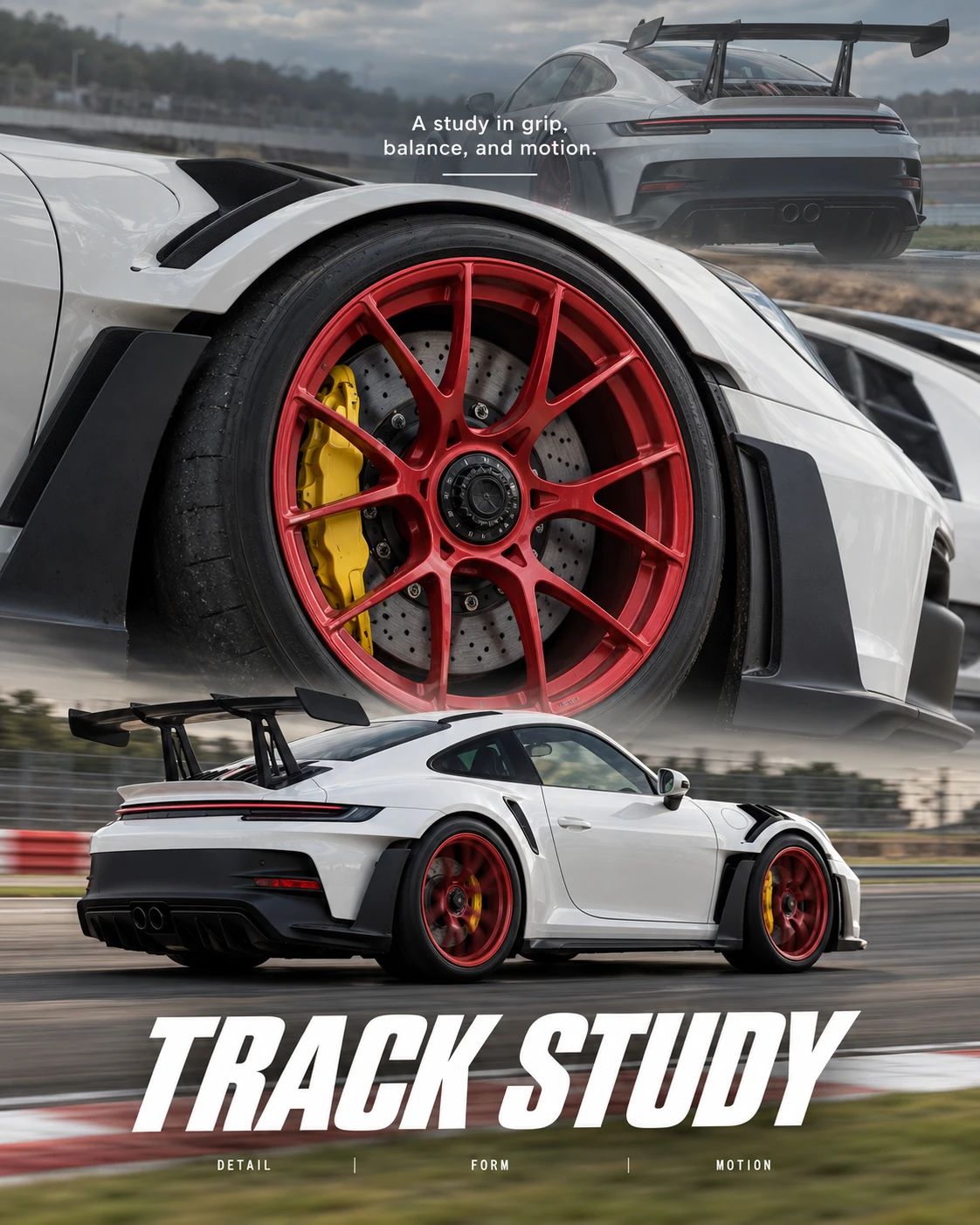
Porsche GT3 RS Track Day Poster
3:40 likesCar EditsCinematic
Prompt
Create a photographic automotive editorial poster combining a large wheel detail, a subtle rear-view image, and a panning track photograph. Use a 4:5 portrait canvas.
OPTIONAL INPUTS
• Vehicle photographs: [Optional]
• Exact make/model/year/variant: [Optional]
• Circuit or location: [Optional]
• Verified specifications: [Optional]
VEHICLE RESEARCH
Prioritize supplied photographs. Preserve the actual bodywork, wing, vents, wheels, brake components, paint, and modifications.
If only a model is named, research manufacturer photographs and technical documentation before generation. Confirm generation-specific details and ensure every image depicts the same configuration.
Without vehicle information, research a white 2023 Porsche 911 GT3 RS, 992-generation, with documented red-wheel and yellow-caliper configuration. Do not invent specifications or combine different versions.
Research any named circuit’s real surface, curbs, barriers, and surroundings. Otherwise use an unnamed closed circuit. If browsing is unavailable, request reference photographs.
Remove logos, sponsor decals, tire branding, identifying plates, and unsupported claims. Blank inputs are absent.
LAYOUT
UPPER BACKGROUND
Place a low-opacity photographic rear-quarter view of the same car across the upper edge. It is a deliberate editorial layer, not a ghost reflection.
CENTRAL DETAIL
Fill the upper-middle canvas with a close photograph of one actual red wheel, tire, brake rotor, and yellow caliper. Keep spoke count, center-lock construction, rotor holes, and caliper position mechanically correct.
LOWER HERO IMAGE
Show the car traveling toward viewer right in rear three-quarter view on a closed track. Keep the complete vehicle recognizable, with the large wing clearly supported.
Blend the photographic layers using restrained masks and tonal transitions. Do not make them appear to occupy one impossible physical space.
CAMERA AND OPTICAL DIRECTION
Wheel detail: full-frame Canon EOS R5-style capture with a 100mm macro lens, approximately f/5.6, ISO 100, camera square to the wheel. Focus on the wheel face; let the nearest tire shoulder and deepest mechanical recesses soften naturally.
Track image: 70–200mm lens near 135mm, approximately 1/80–1/125 second, f/8, ISO adjusted to exposure. Pan with the car. Keep the cabin and body reasonably clear while the road, barriers, and rotating wheels show directionally coherent movement.
Do not use the same sharpness or blur pattern for the stationary wheel detail and moving car.
LIGHTING
Use bright overcast daylight with a consistent neutral color temperature. Retain subdued sky reflections, real tire texture, minor brake dust, and natural contrast.
Allow slight atmospheric softness in distant barriers only. No artificial smoke or dust cloud on a clean circuit.
TYPOGRAPHY AND EXACT COPY
Upper-middle:
“A study in grip,
balance, and motion.”
Use small white sans-serif with one fine horizontal rule below.
Near the bottom:
“TRACK STUDY”
Use large white italic condensed capitals.
Small lower labels:
“DETAIL”
“FORM”
“MOTION”
Replace these with technical figures only when supplied or verified for the exact vehicle.
FINISH AND OUTPUT
Generate one finished 4:5 editorial composite. Preserve neutral whites, detailed dark aero parts, restrained red saturation, and realistic motion.
No fake speed streaks, glowing brakes, grain overlay, exaggerated clarity, repeated rotor holes, warped wheel ellipses, logos, or invented performance claims.