Campaign set · 12 images
Health Awareness Doctor Post Set
Instagram Post Sets
Way 2 · only some AI modelsThe whole set at onceOne master prompt that makes every design together.
Master prompt
Use this only if your AI model can make many images together in one go (multi-image generation). If it makes one image at a time, the result will not match. Use the separate prompts below instead.
Create a coordinated twelve-image healthcare educational social media campaign.
CREATIVE OBJECTIVE
Preserve the reference’s clear medical topics, bold condensed typography, alternating light and colored backgrounds, prominent people, and restrained anatomical imagery.
Create original layouts, copy, photographic arrangements, and graphic structures.
Keep the campaign informative, approachable, and visibly healthcare-focused.
OUTPUT
Generate 12 separate finished images, one per numbered brief.
Each image must have its own complete 4:5 portrait canvas.
Do not combine them into a collage, grid, contact sheet, or multi-panel image.
If necessary, generate the images sequentially.
Exclude the reference’s palette swatches, social-platform icons, white presentation margins, and profile-layout display.
OPTIONAL INPUTS
• Approved staff and personal photographs
• Approved facility photographs
• Approved medical-equipment photographs
• Approved anatomical references
• Clinically reviewed educational copy
• Verified staff roles and services
• Approved replacement headlines
• Approved brand assets
Treat blank fields as absent. Never print placeholders.
ACCURACY
Preserve supplied identities, anatomy, devices, facility layouts, and confirmed medical information.
Do not invent clinician credentials, staff affiliations, patient testimonials, diagnoses, clinical results, services, appointment availability, prices, or contact information.
Without approved staff photographs, illustrative adults must not be presented as verified clinicians.
Use supplied anatomical references first.
Anatomical illustrations must be structurally accurate, restrained, and clearly educational.
No decorative extra organs, glowing disease points, impossible vertebrae, or misleading anatomy.
Use actual supplied equipment faithfully.
Do not substitute scanner categories.
Do not fabricate clinical screens, glucose readings, scans, test results, or patient data.
MEDICAL COPY
Use the exact neutral copy specified below.
Any additional symptoms, screening recommendations, causes, treatment options, vaccine schedules, diagnostic explanations, or health advice must come from supplied clinically reviewed material.
Do not improvise medical recommendations to fill space.
VISUAL IDENTITY
Deep periwinkle: #475A94
Powder blue: #DCE8F0
Warm white: #F6F4EE
Muted apricot: #E8BBA4
Alternate light and periwinkle-led compositions.
Keep anatomy, skin, equipment, and interiors in believable colors.
TYPOGRAPHY
Bold condensed humanist sans-serif headlines.
Clean regular sans-serif supporting copy.
Clear line breaks, readable contrast, approximately 7% safe margins.
GRAPHIC LANGUAGE
Broad rectangular photographic panels, short rules, small corner accents, restrained line illustrations, and open negative space.
Avoid copying the turquoise palette, floating medical bubbles, repeated cross patterns, exact text arrangements, universal screening checklist, and treatment promises.
PHOTOGRAPHIC CHARACTER
Natural full-frame photography.
People:
50–85mm, f/4–f/5.6, 1/200–1/250 second, ISO 200–400.
Objects:
70–85mm, f/5.6–f/8, ISO 100–200.
Interiors:
28–35mm, f/8, tripod if needed.
White balance around 5200K, adjusted to actual lighting.
Soft directional light, restrained fill, natural skin, believable reflections, coherent shadows, gradual depth falloff.
Avoid hard sharpening, HDR halos, plastic skin, exaggerated pores, artificial glow, fake fog, blanket grain, global blur, and distorted equipment.
Anatomy and line illustrations should retain their educational medium rather than receiving photographic lens effects.
COPY
Render only specified English text.
No logos, websites, QR codes, creator credits, watermarks, or invented calls to contact an unidentified provider.
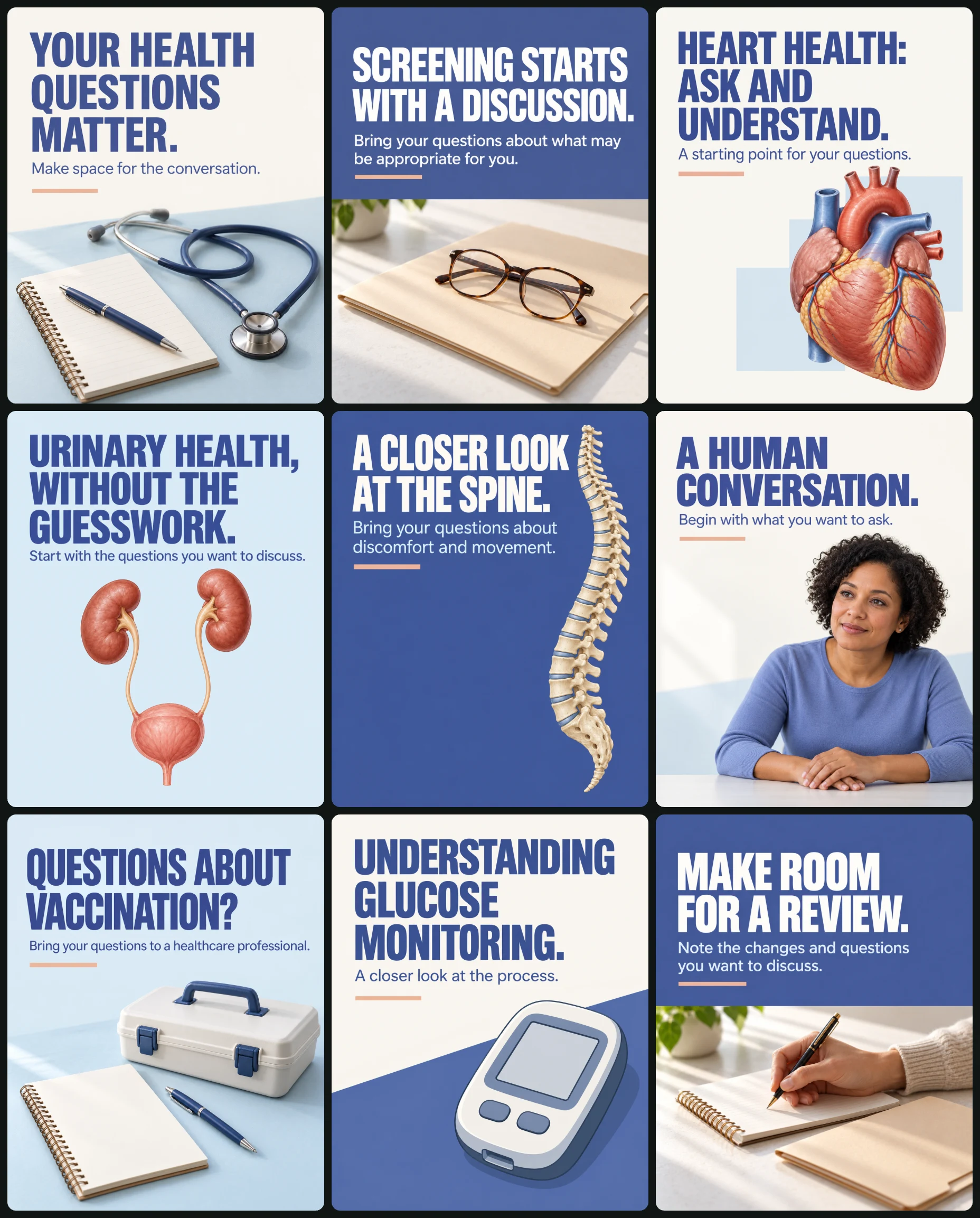
DESIGN 1
Warm-white background.
Notebook, pen, and stethoscope on powder-blue table in lower half.
Headline:
“YOUR HEALTH
QUESTIONS
MATTER.”
Supporting copy:
“Make space for the conversation.”
Apricot rule.
70mm, f/8, soft side light.
DESIGN 2
Periwinkle background, warm-white lower panel.
Approved staff portrait if supplied.
Otherwise plain folder and reading glasses.
Headline:
“SCREENING STARTS
WITH A DISCUSSION.”
Supporting copy:
“Bring your questions about what may be appropriate for you.”
Apricot underline.
No universal test checklist.
DESIGN 3
Warm-white background.
Accurate anatomical heart illustration lower right, restrained natural colors and powder-blue shapes.
Headline:
“HEART HEALTH:
ASK AND
UNDERSTAND.”
Supporting copy:
“A starting point for your questions.”
Apricot rule.
No symptom or emergency advice unless supplied and reviewed.
DESIGN 4
Powder-blue background.
Accurate urinary-system illustration below: kidneys, ureters, bladder.
Natural muted anatomical colors.
Headline:
“URINARY HEALTH,
WITHOUT THE
GUESSWORK.”
Supporting copy:
“Start with the questions you want to discuss.”
No invented causes, diagnosis, or treatment.
DESIGN 5
Periwinkle background.
Accurate lateral spine illustration lower right, ivory bone tones and muted blue-gray discs.
Headline:
“A CLOSER LOOK
AT THE SPINE.”
Supporting copy:
“Bring your questions about discomfort and movement.”
Apricot rule.
No glowing pain points, diagnoses, or treatment claims.
DESIGN 6
Warm-white background, powder-blue portrait backdrop.
Approved clinician portrait when supplied.
Fallback: original adult woman with medium-brown skin and short curly hair, plain periwinkle professional clothing, seated with hands resting on table.
No invented clinician identity.
Headline:
“A HUMAN
CONVERSATION.”
Supporting copy:
“Begin with what you want to ask.”
Apricot underline.
85mm, f/4.
DESIGN 7
Powder-blue background.
Approved vaccination image if supplied.
Otherwise closed plain medical supply case and blank appointment notebook.
Headline:
“QUESTIONS ABOUT
VACCINATION?”
Supporting copy:
“Bring your questions to a healthcare professional.”
No invented procedure, schedule, eligibility, or vaccine label.
DESIGN 8
Warm-white background with periwinkle lower-right panel.
Accurate supplied glucose-monitor photograph.
Fallback: clearly diagrammatic generic monitor with blank screen.
Headline:
“UNDERSTANDING
GLUCOSE
MONITORING.”
Supporting copy:
“A closer look at the process.”
Apricot accent.
No invented reading, finger-prick procedure, target range, or treatment advice.
DESIGN 9
Periwinkle background, warm-white lower photographic panel.
Adult hand writing in an indistinct notebook beside a closed folder.
Headline:
“MAKE ROOM
FOR A REVIEW.”
Supporting copy:
“Note the changes and questions you want to discuss.”
Powder-blue supporting type, apricot rule.
70mm, f/5.6.
DESIGN 10
Warm-white canvas, powder-blue photographic frame.
Use supplied scanner-room image faithfully.
Fallback: abstract quiet clinical corridor with no scanner or facility identity.
Headline:
“QUESTIONS
ABOUT A SCAN?”
Supporting copy:
“Ask about its purpose and what to expect.”
Apricot corner accent.
28–35mm architectural perspective.
DESIGN 11
Powder-blue background.
Original adult man with dark skin, closely cropped hair, cream shirt, seated making notes with a thoughtful expression.
Headline:
“HEADACHE QUESTIONS,
CLEARLY NOTED.”
Supporting copy:
“Make space for what you want to discuss.”
Apricot accent.
50mm, f/4.
No cure, prevention, or medication claims.
DESIGN 12
Warm-white background, periwinkle upper-left text panel.
Original older adult woman with light-brown skin and silver tied-back hair seated beside a window.
Plain glass of water on table, thoughtful gaze outside.
Ivory headline:
“BEGIN WITH
EVERYDAY
QUESTIONS.”
Periwinkle supporting copy:
“What would you like to understand better?”
Powder-blue accents, apricot underline.
50mm, f/4.
No prescribed habits, intake targets, or guaranteed benefits.
FINAL CHECK
Deliver twelve separate portrait artworks.
Keep each topic recognizable and each composition distinct.
Preserve supplied identities, equipment, facilities, and reviewed information.
Check anatomy, device geometry, reflections, hand positions, contrast, and exact spelling.
All 12 images in this set
Each image has its own prompt. Tap an image to see it bigger.
Create one finished 4:5 portrait healthcare editorial poster.
Warm-white #F6F4EE background, deep-periwinkle #475A94 typography, powder-blue #DCE8F0 panels, muted-apricot #E8BBA4 accents.
Use a bold condensed humanist sans-serif headline and clean regular supporting text.
Headline at upper left:
“YOUR HEALTH
QUESTIONS
MATTER.”
Supporting copy:
“Make space for the conversation.”
Photograph a plain notebook, pen, and stethoscope across the lower half on a powder-blue tabletop. Use supplied objects faithfully. No readable medical records.
Full-frame camera character, Canon EOS R6 Mark II, 70mm lens, f/8, ISO 100, 1/160 second, 5200K. Broad soft side light, realistic tubing, subtle paper texture, coherent shadows.
Add one short apricot rule. Maintain 7% margins.
No invented appointment availability, clinician credentials, treatment claims, logos, contacts, QR codes, or watermark. Avoid hard sharpening, fake glow, and excessive grain. Flat artwork only.
Screening starts with a conversation
Create one finished 4:5 portrait healthcare awareness poster.
Deep-periwinkle #475A94 background with a warm-white #F6F4EE rectangular panel across the lower half.
Headline:
“SCREENING STARTS
WITH A DISCUSSION.”
Supporting copy:
“Bring your questions about what may be appropriate for you.”
Use bold condensed humanist sans serif and a small apricot #E8BBA4 underline.
Place an approved staff portrait within the lower panel, preserving identity and verified role. Without staff input, use a neutral still life of an unmarked folder and folded reading glasses instead.
Do not reproduce a universal checklist of examinations or suggest that every person needs the same tests.
For photography: 85mm lens character, f/5.6–f/8, soft diffused light, neutral white balance, natural detail.
No invented medical recommendations, credentials, service availability, prices, logos, contacts, or watermark. Render only the specified copy.
Heart Health: Ask and Understand
Create one finished 4:5 portrait heart-health educational poster.
Warm-white #F6F4EE background. Deep-periwinkle #475A94 headline:
“HEART HEALTH:
ASK AND
UNDERSTAND.”
Supporting copy:
“A starting point for your questions.”
Place a restrained, anatomically accurate heart illustration in the lower-right half, using natural muted anatomical colors with powder-blue #DCE8F0 supporting shapes. Use an approved anatomical reference when supplied.
Keep the illustration clearly educational, without glowing arteries, decorative vessels, or dramatic injury.
Bold condensed humanist sans-serif headline, regular supporting text, small muted-apricot #E8BBA4 caption rule.
Do not show a distressed person as a substitute for explaining symptoms. Do not invent emergency guidance, symptom lists, risk claims, or treatment advice.
Only supplied clinically reviewed copy may expand the information. No logos, contacts, badges, or watermark. Flat artwork.
Urinary system, clearly explained
Create one finished 4:5 portrait urinary-health educational poster.
Powder-blue #DCE8F0 background, deep-periwinkle #475A94 type, warm-white #F6F4EE information area, restrained apricot #E8BBA4 accent.
Headline at upper left:
“URINARY HEALTH,
WITHOUT THE
GUESSWORK.”
Supporting copy:
“Start with the questions you want to discuss.”
Place a simple accurate urinary-system illustration across the lower half, showing kidneys, ureters, and bladder with clear anatomical relationships. Use supplied approved medical imagery first.
Use restrained natural colors and diagrammatic shading rather than glossy turquoise organs. No unrelated reproductive anatomy or invented labels.
Bold condensed humanist sans-serif typography, generous margins.
Do not invent causes, diagnosis, recurrence explanations, treatment, or prevention advice. Additional medical content must be supplied and clinically reviewed.
No logos, credentials, contacts, QR codes, or watermark.
A closer look at the spine
Create one finished 4:5 portrait spine-health educational poster.
Deep-periwinkle #475A94 background.
Warm-white headline at upper left:
“A CLOSER LOOK
AT THE SPINE.”
Supporting copy:
“Bring your questions about discomfort and movement.”
Place an accurate lateral spine illustration in the lower-right two-thirds. Maintain plausible vertebral proportions, natural curvature, and consistent disc spacing. Use approved anatomical references when supplied.
Use ivory bone tones and muted blue-gray discs. No glowing pain points, exaggerated disc bulges, impossible vertebrae, or dramatic twisting.
Bold condensed humanist sans serif with a small apricot #E8BBA4 rule. Keep text separate from the anatomy.
No treatment promises, named diagnoses, cure claims, or exercise instructions. Use only supplied clinically reviewed medical explanations.
No logos, contact details, QR codes, or watermark. Flat educational artwork.
A human conversation about care
Create one finished 4:5 portrait healthcare professional-themed poster.
Use approved staff imagery and verified roles when supplied. Preserve the person’s identity and appearance.
Without staff input, show an original adult woman with medium-brown skin and short curly hair in plain periwinkle professional clothing. Do not assign medical credentials or present her as verified clinic staff.
Warm-white #F6F4EE background. Seated portrait at lower left, with natural hands resting on a table. Powder-blue #DCE8F0 rectangular backdrop behind her.
Periwinkle #475A94 headline at upper right:
“A HUMAN
CONVERSATION.”
Supporting copy:
“Begin with what you want to ask.”
Bold condensed humanist sans serif, apricot #E8BBA4 underline.
Full-frame camera, 85mm lens, f/4, 1/200 second, ISO 200–400, 5200K. Soft side light, natural skin, gentle depth falloff.
No invented white coat, stethoscope, qualifications, guarantees, logos, contacts, or watermark.
Vaccination questions, medical case and notebook
Create one finished 4:5 portrait vaccination-awareness poster.
Powder-blue #DCE8F0 background, deep-periwinkle #475A94 typography, warm-white #F6F4EE panels, muted-apricot #E8BBA4 accent.
Headline:
“QUESTIONS ABOUT
VACCINATION?”
Supporting copy:
“Bring your questions to a healthcare professional.”
Use a supplied approved vaccination photograph if available, preserving the actual equipment and procedure.
Without approved procedural imagery, show a closed plain medical supply case and blank appointment notebook on a clean table. Do not invent an injection procedure, needle placement, vaccine vial label, or product.
Typography: bold condensed humanist sans serif with readable supporting text.
Photographic character: 70mm lens, f/8, soft diffused light, neutral white balance, natural material detail.
No vaccine schedule, eligibility list, efficacy figures, availability, price, provider identity, logos, contacts, or watermark. Additional medical copy must be supplied and clinically reviewed.
Understanding glucose monitoring
Create one finished 4:5 portrait glucose-monitoring educational poster.
Warm-white #F6F4EE background with a deep-periwinkle #475A94 lower-right panel.
Headline:
“UNDERSTANDING
GLUCOSE
MONITORING.”
Supporting copy:
“A closer look at the process.”
Use supplied approved device photography accurately, preserving device shape, buttons, test-strip arrangement, and confirmed display. Redact personal data.
Without device imagery, use a restrained line illustration of a generic handheld monitor with a blank screen, clearly diagrammatic rather than a verified commercial product.
Do not invent a glucose reading, perform a simulated finger-prick procedure, or show unsupported device operation.
Bold condensed humanist sans serif, powder-blue #DCE8F0 supporting shapes, small apricot #E8BBA4 accent.
No symptom list, diagnosis, target range, treatment advice, logos, contacts, or watermark. Use only supplied clinically reviewed medical information.
Make room for a review
Create one finished 4:5 portrait healthcare conversation poster.
Deep-periwinkle #475A94 background with a warm-white #F6F4EE photographic panel across the lower 65%.
Show a natural adult hand writing in a plain notebook beside a closed folder. Keep pages blank or indistinct, with no fabricated clinical records.
Headline in warm white:
“MAKE ROOM
FOR A REVIEW.”
Supporting copy:
“Note the changes and questions you want to discuss.”
Use bold condensed humanist sans serif, powder-blue #DCE8F0 supporting text, and one apricot #E8BBA4 rule.
Full-frame camera character, 70mm lens, f/5.6, 1/200 second, ISO 200, 5200K. Soft window light, realistic hand anatomy, natural paper and shadows.
No heart-shaped prop, implied screening benefit, hidden-disease detection claim, appointment promise, logos, contacts, or watermark. Flat artwork.
Questions about a scan
Create one finished 4:5 portrait diagnostic-imaging information poster.
Warm-white #F6F4EE canvas with deep-periwinkle #475A94 typography and a broad powder-blue #DCE8F0 photographic frame.
Headline at upper left:
“QUESTIONS
ABOUT A SCAN?”
Supporting copy:
“Ask about its purpose and what to expect.”
Use an actual supplied imaging-room photograph faithfully, preserving the scanner type, room layout, equipment, and proportions. Do not substitute an MRI scanner for a CT scanner or invent screen imagery.
Without equipment photographs, show an abstract architectural crop of a quiet clinical corridor with no scanner, signage, or implied facility identity.
Bold condensed humanist sans serif, small apricot #E8BBA4 corner accent.
Natural architectural photography, 28–35mm lens character, controlled verticals, neutral light, restrained detail.
No scan recommendation, availability, safety guarantee, results promise, logo, contact information, or watermark.
Thoughtful notes for clearer headache questions
Create one finished 4:5 portrait headache-awareness editorial poster.
Powder-blue #DCE8F0 background.
Show an original adult man with dark skin, closely cropped hair, and a cream shirt, seated at a table and making notes. His expression is thoughtful, without an exaggerated pain pose.
Preserve supplied personal identity if provided. Keep notebook content unreadable.
Periwinkle #475A94 headline in the upper third:
“HEADACHE QUESTIONS,
CLEARLY NOTED.”
Supporting copy:
“Make space for what you want to discuss.”
Bold condensed humanist sans serif, small muted-apricot #E8BBA4 accent.
Full-frame camera, 50mm lens, f/4, 1/200 second, ISO 400, 5200K. Soft window light, natural skin, gentle background softness.
No “goodbye headaches” claim, prevention promise, diagnosis, medication, symptom triage, clinician identity, logos, contacts, or watermark. Additional medical information requires supplied reviewed copy.
Begin with everyday questions
Create one finished 4:5 portrait everyday-wellbeing editorial poster.
Warm-white #F6F4EE background with a deep-periwinkle #475A94 text panel across the upper-left area.
Show an original older adult woman with light-brown skin and silver tied-back hair, seated beside a bright window. A plain glass of water rests on the table; she looks thoughtfully outside.
Preserve supplied identity if provided. Do not present her as a patient testimonial.
Ivory headline:
“BEGIN WITH
EVERYDAY
QUESTIONS.”
Periwinkle supporting copy:
“What would you like to understand better?”
Powder-blue #DCE8F0 photographic accents and one muted-apricot #E8BBA4 underline. Bold condensed humanist sans-serif typography.
Full-frame camera, 50mm lens, f/4, 1/250 second, ISO 400, neutral daylight white balance. Natural age-related skin detail, gentle shadows, restrained reflections.
No numbered health-habit claims, prescribed water intake, guaranteed benefits, logos, contact details, or watermark.