Campaign set · 9 images
Patient Care Clinic Instagram Post Set
Instagram Post Sets
Way 2 · only some AI modelsThe whole set at onceOne master prompt that makes every design together.
Master prompt
Use this only if your AI model can make many images together in one go (multi-image generation). If it makes one image at a time, the result will not match. Use the separate prompts below instead.
Create a coordinated nine-image healthcare social media campaign.
CREATIVE OBJECTIVE
Preserve the reference’s welcoming clinical character:
reassuring people, clean imagery, readable information, soft shapes, and clear hierarchy.
Create original compositions, typography, copy, photographic arrangements, and color relationships.
Keep the design approachable and professional without implying unverified services or clinical outcomes.
OUTPUT
Generate 9 separate finished images, one per numbered brief.
Each image must have its own complete 4:5 portrait canvas.
Do not combine them into a collage, grid, contact sheet, or multi-panel image.
If necessary, generate the images sequentially.
Deliver flat artwork without presentation gutters, screens surrounding the artwork, frames, or software interfaces.
OPTIONAL INPUTS
• Approved clinic photographs
• Approved staff photographs and verified roles
• Medical-equipment photographs
• Confirmed services
• Approved appointment information
• Personal photographs
• Approved replacement copy
• Approved brand assets
Treat blank fields as absent. Never print placeholders.
INPUT ACCURACY
Use supplied photographs and confirmed information first.
Preserve actual clinic layout, equipment, materials, furniture, and architectural proportions.
Preserve supplied identities, ages, skin tones, facial features, hairstyles, and body proportions.
Do not fabricate staff names, clinician roles, credentials, experience, affiliations, patient testimonials, or treatment results.
Without approved staff imagery, use the illustrative adults described below in neutral professional clothing. Do not present them as verified clinic employees.
Without clinic imagery, conceptual interiors must not imply an actual facility.
MEDICAL EQUIPMENT
Use supplied equipment accurately.
Preserve probes, cables, controls, geometry, and confirmed labeling.
Do not invent scan imagery, patient data, or diagnostic results.
Without equipment photographs, use the neutral editorial still life specified in design 6.
VISUAL IDENTITY
Cornflower blue: #527FC5
Warm ivory: #F7F4ED
Pale peach: #EBCDBD
Deep navy: #25384D
Use blue for calm visual confidence, peach for warmth, ivory for clarity, and navy for readable contrast.
Preserve natural skin and photographic colors.
TYPOGRAPHY
Friendly humanist sans serif.
Bold headlines with clean regular supporting text.
Clear line breaks, generous spacing, approximately 7% margins.
GRAPHIC LANGUAGE
Broad rounded rectangles, offset photographic panels, narrow dividers, and restrained accent blocks.
Avoid copying the reference’s teal palette, heart-shaped medical prop, exact curved frames, discount badge, service grid, and contact footer.
PHOTOGRAPHIC DIRECTION
Natural full-frame commercial photography.
People:
50–85mm lens, f/4–f/5.6, 1/200 second, ISO 200–400.
Soft window-like key, gentle fill, natural skin.
Interiors:
28mm lens, f/8, ISO 200, tripod exposure as needed.
Controlled verticals and believable room proportions.
Objects and equipment:
70–85mm lens, f/5.6–f/8, ISO 100–200, 1/160 second.
Neutral white balance around 5200K, adjusted to actual lighting.
Maintain coherent anatomy, hand contact, equipment geometry, room scale, reflections, and grounded shadows.
Keep important details clear with gradual depth falloff.
Avoid harsh sharpening, HDR halos, plastic skin, exaggerated pores, fake glow, theatrical haze, cloned objects, blanket grain, and global blur.
COPY AND CLAIMS
Render only the exact English copy below.
Do not invent:
Clinical services.
Staff credentials.
Diagnostic accuracy.
Treatment effectiveness.
Health outcomes.
Same-day results.
Queue-free visits.
Appointment availability.
Discounts or prices.
Personalized programs.
Equipment capabilities.
Contact information.
Logos, websites, QR codes, or watermarks.
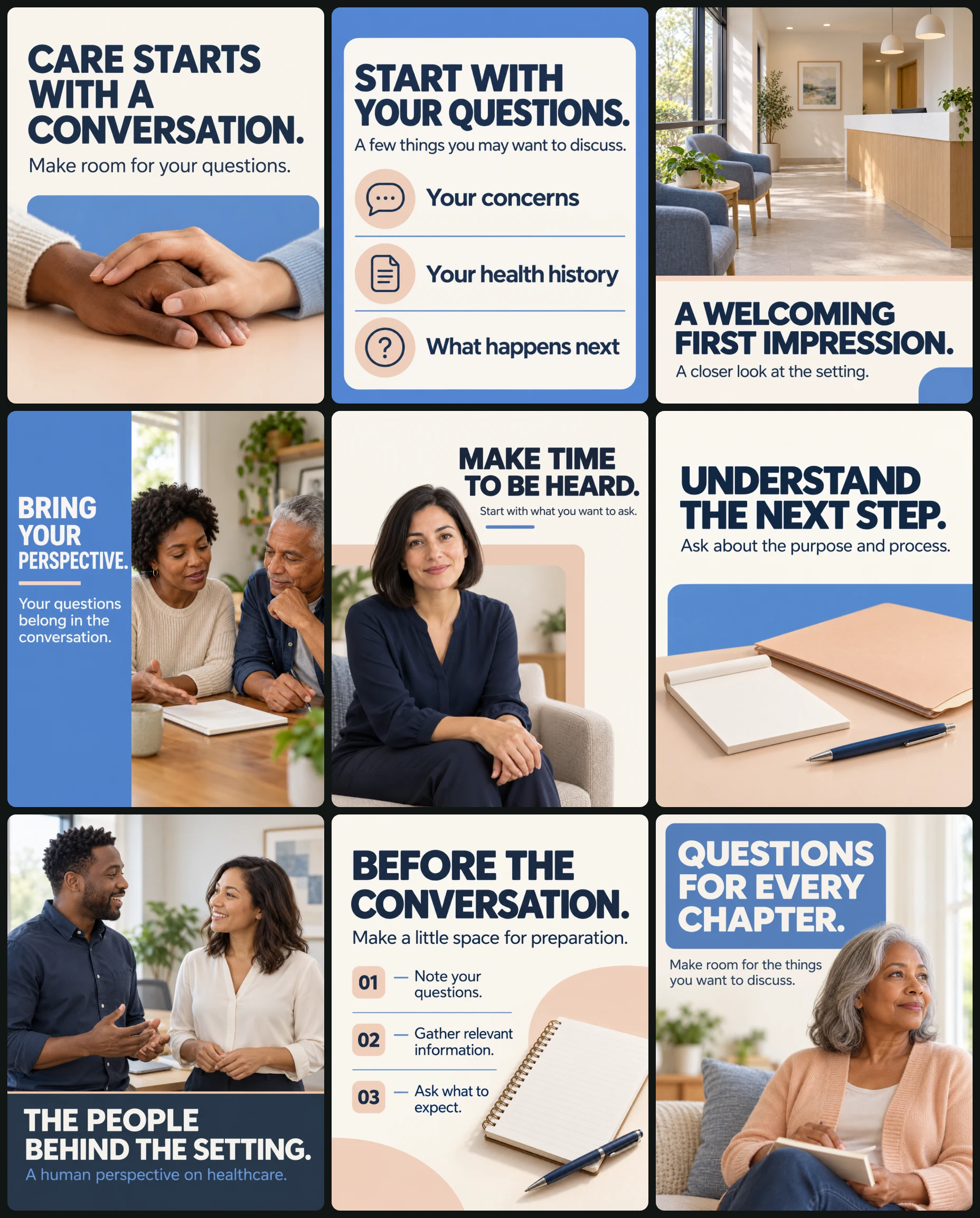
DESIGN 1 — CARE STARTS WITH A CONVERSATION
Ivory background.
Close photograph of two adult hands resting together on a peach tabletop, one gently supporting the other, across lower half.
Blue rounded rectangle offset behind photograph.
Navy headline:
“CARE STARTS
WITH A
CONVERSATION.”
Supporting copy:
“Make room for your questions.”
85mm, f/5.6, soft window-like light.
No heart prop or medical cross.
DESIGN 2 — START WITH YOUR QUESTIONS
Blue background.
Large ivory panel in lower two-thirds.
Navy headline:
“START WITH
YOUR QUESTIONS.”
Supporting copy:
“A few things you may want to discuss.”
Three spacious rows:
Speech bubble icon — “Your concerns”
Plain document icon — “Your health history”
Question mark icon — “What happens next”
Peach accents and thin blue dividers.
Flat clean editorial graphics, no photographic effects.
Topics are not a service list.
DESIGN 3 — A WELCOMING FIRST IMPRESSION
Clinic-interior photograph across upper 70%.
Use supplied clinic faithfully.
Fallback: conceptual modest reception desk, comfortable chairs, natural light, restrained planting.
Ivory lower caption area, peach divider.
Navy headline:
“A WELCOMING
FIRST IMPRESSION.”
Supporting copy:
“A closer look at the setting.”
Small blue corner block.
28mm, f/8, soft daylight.
DESIGN 4 — BRING YOUR PERSPECTIVE
Home photograph across right 65%.
Two original adults:
Woman with dark skin and short natural curls.
Older man with medium-brown skin and gray hair.
They sit at a table looking at a plain notebook, naturally attentive.
Do not assign a relationship or imply patient status.
Blue left text column.
Ivory headline:
“BRING YOUR
PERSPECTIVE.”
Supporting copy:
“Your questions belong in the conversation.”
Peach underline.
50mm, f/4, soft window light.
DESIGN 5 — MAKE TIME TO BE HEARD
Ivory canvas.
Portrait across lower-left two-thirds, peach panel behind.
Use approved staff photograph and verified role if supplied.
Fallback: original adult woman in plain navy professional clothing, seated in a neutral consultation-style room, without clinician credentials or medical props.
Navy headline at upper right:
“MAKE TIME
TO BE HEARD.”
Supporting copy:
“Start with what you want to ask.”
Short blue rule.
85mm, f/4, broad soft key.
DESIGN 6 — UNDERSTAND THE NEXT STEP
Ivory background with blue lower-third panel.
Use supplied equipment accurately in lower-right two-thirds.
No fabricated clinical imagery.
Fallback:
Closed plain folder, unmarked notepad, and pen.
Navy headline:
“UNDERSTAND
THE NEXT STEP.”
Supporting copy:
“Ask about the purpose and process.”
Peach accent rectangle.
70mm, f/8, controlled reflections.
DESIGN 7 — PEOPLE BEHIND THE SETTING
Photograph upper 72%.
Use approved real team imagery when supplied.
Fallback:
Original man with dark skin and short textured hair, and woman with light-brown skin and shoulder-length dark hair.
Neutral professional clothing, standing beside a desk and looking toward each other.
Do not imply verified clinic staff status.
Navy lower caption panel, peach top rule.
Ivory headline:
“THE PEOPLE
BEHIND THE SETTING.”
Supporting copy:
“A human perspective on healthcare.”
Blue accent.
50mm, f/5.6, soft window light.
DESIGN 8 — BEFORE THE CONVERSATION
Ivory background with navy type, blue dividers, peach accents.
Headline:
“BEFORE THE
CONVERSATION.”
Supporting copy:
“Make a little space for preparation.”
Three editorial sections:
“01 — Note your questions.”
“02 — Gather relevant information.”
“03 — Ask what to expect.”
Plain notebook and pen photographed at lower right.
70mm, f/8, soft side light.
General preparation prompts only, not a booking procedure or treatment protocol.
DESIGN 9 — QUESTIONS FOR EVERY CHAPTER
Original older adult woman with medium-brown skin, silver shoulder-length hair, peach cardigan.
Waist-up sitting-room portrait at lower right.
Notebook in lap, thoughtful gaze toward window.
Blue upper-left headline panel, ivory surroundings.
Ivory headline:
“QUESTIONS
FOR EVERY
CHAPTER.”
Navy supporting copy:
“Make room for the things you want to discuss.”
85mm, f/4, soft daylight.
No patient testimonial or program claim.
FINAL CHECK
Deliver nine separate portrait artworks.
Maintain warmth, clarity, distinct layouts, natural people, and a coordinated identity.
Preserve supplied clinical information accurately.
Check anatomy, equipment, perspective, personal data, shadows, and exact readable copy.
All 9 images in this set
Each image has its own prompt. Tap an image to see it bigger.
Create one finished 4:5 portrait healthcare campaign advertisement.
DESIGN
Warm ivory #F7F4ED background, cornflower blue #527FC5, pale peach #EBCDBD, and deep navy #25384D.
Place a photographic close-up of two adult hands resting naturally together on a pale-peach tabletop across the lower half. One hand gently supports the other. Keep the gesture respectful and anatomically plausible.
Use a broad blue rounded rectangle behind the photograph, offset toward the right. Avoid a heart-shaped medical prop or cross symbol.
Navy headline at upper left:
“CARE STARTS
WITH A
CONVERSATION.”
Supporting copy:
“Make room for your questions.”
Use a friendly humanist sans serif, mixing bold headline words with regular supporting text. Maintain approximately 7% margins.
PHOTOGRAPHY
Full-frame camera character, Canon EOS R6 Mark II, 85mm lens, f/5.6, 1/200 second, ISO 200, neutral white balance around 5200K.
Large soft window-like key, gentle fill, natural skin, subtle contact shadows.
No plastic skin, exaggerated wrinkles, hard sharpening, fake glow, medical outcome promises, invented services, branding, contact details, QR codes, or watermark. Deliver flat artwork.
Start with your questions
Create one finished 4:5 portrait informational healthcare poster.
DESIGN
Cornflower-blue #527FC5 background with a large warm-ivory #F7F4ED panel occupying the lower two-thirds.
Deep-navy #25384D headline:
“START WITH
YOUR QUESTIONS.”
Supporting copy:
“A few things you may want to discuss.”
Inside the ivory panel, arrange three generously spaced horizontal rows, each with one simple original navy line icon and a short label:
Speech bubble:
“Your concerns”
Plain document:
“Your health history”
Question mark:
“What happens next”
Use pale-peach #EBCDBD small rectangular accents and thin blue dividers. Keep this a clean editorial information design, not an app dashboard.
Typography: friendly humanist sans serif with clear size hierarchy and approximately 7% margins.
These are discussion topics, not a list of clinical services. If approved replacement topics are supplied, use their exact wording.
No specialty claims, invented staff credentials, diagnostic promises, hospital logos, dates, contact information, QR codes, or watermark. Keep graphic edges clean; no photographic grain, haze, or 3D effects.
Welcoming reception interior
Create one finished 4:5 portrait clinic-interior campaign advertisement.
LOCATION INPUT
Use supplied clinic photographs faithfully. Preserve actual layout, furniture, materials, signage structure, and equipment. Remove branding unless approved.
Without input, show an original conceptual reception interior, not an actual facility: a modest reception desk, comfortable chairs, natural light, and restrained planting.
COMPOSITION
Large rectangular interior photograph across the upper 70%.
Warm-ivory #F7F4ED lower caption area with a narrow pale-peach #EBCDBD divider.
Navy #25384D headline:
“A WELCOMING
FIRST IMPRESSION.”
Supporting copy:
“A closer look at the setting.”
Add one small cornflower-blue #527FC5 corner block. Use a friendly humanist sans serif.
PHOTOGRAPHY
Full-frame camera, 28mm lens, f/8, ISO 200, tripod exposure as needed. Neutral daylight white balance, soft window light, believable room proportions, controlled verticals, readable shadows.
No exaggerated room expansion, invented signage, fake equipment, hospital-scale grandeur, HDR halos, hard sharpening, accessibility claims, modern-equipment claims, contacts, logos, or watermark.
Two adults sharing perspective at home
Create one finished 4:5 portrait people-centered healthcare advertisement.
PEOPLE
Preserve supplied identities and relationships accurately.
Without input, show two distinct original adults: a woman with dark skin and short natural curls, and an older man with medium-brown skin and gray hair. Present them as illustrative subjects without identifying their relationship.
COMPOSITION
Quiet home setting. They sit together at a table, looking at a plain notebook with natural, attentive expressions. No visible medical records or readable personal information.
Photograph occupies the right 65%. Cornflower-blue #527FC5 text column at left.
Ivory #F7F4ED headline:
“BRING YOUR
PERSPECTIVE.”
Supporting copy:
“Your questions belong in the conversation.”
Use friendly humanist sans serif and one pale-peach #EBCDBD underline.
PHOTOGRAPHY
Full-frame camera, 50mm lens, f/4, 1/200 second, ISO 400, white balance around 5200K.
Soft window light, natural skin, relaxed posture, gradual background softness.
No implication of a real patient testimonial, family-service availability, treatment result, exaggerated smiles, plastic skin, logos, contacts, or watermark.
Make time to be heard
Create one finished 4:5 portrait healthcare professional-themed advertisement.
PERSON INPUT
Use approved staff photographs and verified roles when supplied. Preserve identity, age, skin tone, features, clothing, and proportions.
Without input, show an original adult woman in plain navy professional clothing, seated in a neutral consultation-style room. Do not present her as a named clinician or assign credentials.
COMPOSITION
Warm-ivory #F7F4ED canvas.
Portrait across the lower-left two-thirds, hands resting naturally on a table.
Pale-peach #EBCDBD panel offset behind the portrait.
Deep-navy #25384D headline at upper right:
“MAKE TIME
TO BE HEARD.”
Supporting copy:
“Start with what you want to ask.”
Cornflower-blue #527FC5 short rule. Friendly humanist sans-serif typography.
PHOTOGRAPHY
Full-frame camera, 85mm lens, f/4, 1/200 second, ISO 200–400, neutral 5200K white balance.
Broad soft key, gentle fill, natural facial detail, readable shadows.
No invented white-coat identity, stethoscope, specialist title, discount, waiting-time promise, care guarantee, plastic skin, hard sharpening, logo, contact details, or watermark.
Understanding the next step
Create one finished 4:5 portrait healthcare information advertisement.
EQUIPMENT INPUT
Use supplied medical-equipment photographs accurately. Preserve model geometry, probes, cables, controls, screen structure, and confirmed labels. Do not fabricate clinical imagery or patient data.
Without equipment input, use an editorial still life of a closed plain folder, an unmarked notepad, and a pen. Do not invent diagnostic equipment.
COMPOSITION
Warm-ivory #F7F4ED background with a cornflower-blue #527FC5 horizontal panel across the lower third.
Place the supplied equipment or fallback still life in the lower-right two-thirds, grounded naturally.
Navy #25384D headline at upper left:
“UNDERSTAND
THE NEXT STEP.”
Supporting copy:
“Ask about the purpose and process.”
Pale-peach #EBCDBD accent rectangle. Friendly humanist sans serif with clear hierarchy.
PHOTOGRAPHY
Full-frame camera, 70mm lens, f/8, ISO 100–200, 1/160 second, neutral white balance.
Large diffused key, restrained reflections, coherent cables if present, natural contact shadows.
No diagnostic-accuracy claim, treatment-effectiveness claim, same-day results, invented scan, technology promise, logos, contacts, QR codes, or watermark.
Human connection in healthcare
Create one finished 4:5 portrait healthcare team-themed advertisement.
PEOPLE INPUT
Use supplied approved team photographs faithfully. Do not invent names, roles, qualifications, experience, or affiliations.
Without input, show two original adults in neutral professional clothing in a bright shared workspace: a man with dark skin and short textured hair, and a woman with light-brown skin and shoulder-length dark hair. Treat them as illustrative people, not verified clinic staff.
COMPOSITION
Photograph across the upper 72%, with both people standing naturally beside a plain desk, looking toward each other.
Deep-navy #25384D caption panel across the lower 28%, with a pale-peach #EBCDBD top rule.
Ivory #F7F4ED headline:
“THE PEOPLE
BEHIND THE SETTING.”
Supporting copy:
“A human perspective on healthcare.”
Use a friendly humanist sans serif. Cornflower-blue #527FC5 small accent.
PHOTOGRAPHY
Full-frame camera, 50mm lens, f/5.6, 1/200 second, ISO 400, 5200K.
Soft window light, coherent scale, natural posture and skin.
No invented clinician uniforms, specialist claims, credentials, years of experience, patient testimonials, logos, contacts, or watermark.
Before the Conversation: Prepare Thoughtfully
Create one finished 4:5 portrait healthcare preparation poster.
DESIGN
Warm-ivory #F7F4ED background with deep-navy #25384D typography, cornflower-blue #527FC5 dividers, and pale-peach #EBCDBD accents.
Headline:
“BEFORE THE
CONVERSATION.”
Supporting copy:
“Make a little space for preparation.”
Arrange three simple editorial text sections down the left:
“01 — Note your questions.”
“02 — Gather relevant information.”
“03 — Ask what to expect.”
These are general preparation prompts, not the clinic’s booking procedure or medical instructions.
Place a photographic still life of a plain notebook and pen in the lower-right corner. No invented prescription, test result, or personal details.
PHOTOGRAPHY
Full-frame camera, 70mm lens, f/8, ISO 100, 1/160 second, neutral 5200K.
Soft side light, subtle paper texture, realistic shadows.
Use friendly humanist sans-serif typography, ample spacing, and approximately 7% margins.
No booking guarantees, queue promises, treatment steps, medical claims, logos, contact information, QR codes, or watermark. Deliver flat artwork.
Questions for every chapter
Create one finished 4:5 portrait healthcare lifestyle advertisement.
PEOPLE
Preserve supplied identities. Otherwise show an original older adult woman with medium-brown skin, silver shoulder-length hair, and a pale-peach cardigan.
COMPOSITION
Natural portrait in a bright sitting room, framed from the waist up. She holds a plain notebook in her lap and looks thoughtfully toward the window.
Place the person in the lower-right two-thirds.
Use a broad cornflower-blue #527FC5 rectangle behind the upper-left text area, with warm-ivory #F7F4ED negative space around it.
Ivory headline:
“QUESTIONS
FOR EVERY
CHAPTER.”
Navy #25384D supporting copy below the blue panel:
“Make room for the things you want to discuss.”
Friendly humanist sans serif, no checklist or program badge.
PHOTOGRAPHY
Full-frame camera, 85mm lens, f/4, 1/200 second, ISO 400, 5200K.
Soft daylight, natural age-related skin detail, gentle shadows, gradual background softness.
No age reversal, treatment implication, patient testimonial, program availability, exaggerated happiness, plastic skin, hard sharpening, logos, contacts, or watermark.