Food Ads
Chaat Masala Spice Ad
3:40 likesFood AdsCinematic
Prompt
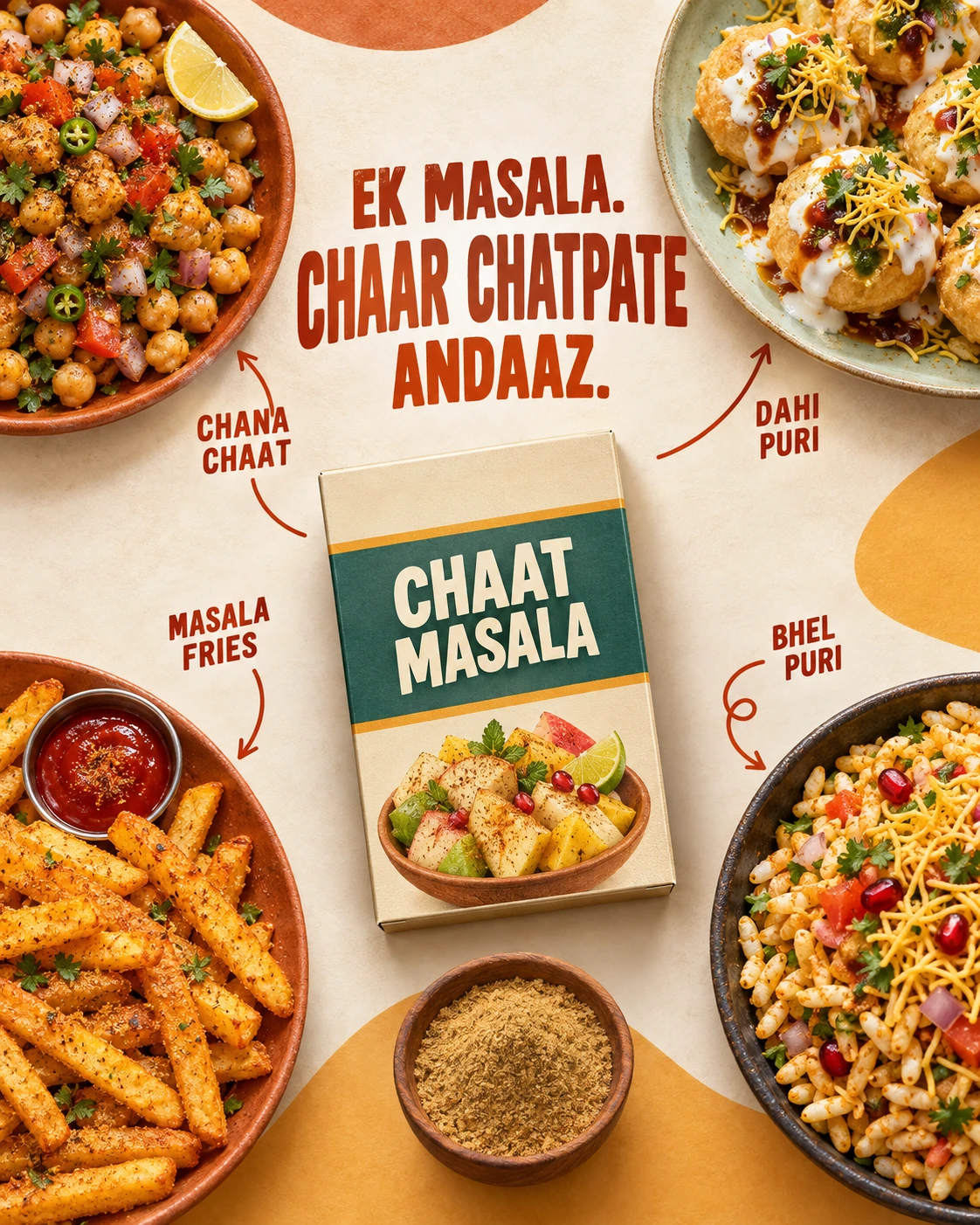
Create a vibrant Indian food advertisement communicating one clear idea: ONE SEASONING BRINGS FLAVOR TO MULTIPLE EVERYDAY DISHES. Use an overhead food-photography composition with the seasoning pack at the center, four appetizing dishes around the corners, and playful hand-drawn arrows connecting the product to its uses.
Preserve this product-to-food relationship. Do not replace the seasoning with an unrelated lifestyle product. Include readable promotional text, but no brand names or logos.
OPTIONAL CUSTOMIZATION
• Product: [Use attached product or supplied details]
• Product category: [Chaat masala / versatile savory seasoning]
• Four dishes: [Automatically select relevant uses]
• Headline: [Automatically match the product]
• Palette: [Warm ivory, deep terracotta, muted saffron]
• Aspect ratio: [4:5 portrait]
AUTOMATIC PRODUCT AND CONCEPT RULES
If a separate product photograph is supplied, use its actual packaging shape, proportions, materials, and colors. Remove visible brand names and logos for this design while retaining a clear generic product descriptor.
If product details are supplied without a photograph, create that product.
If neither is supplied, automatically create a believable unbranded chaat masala pack. Stay within the reference’s seasoning category and preserve its multiple-food-use concept. Do not ask for clarification.
Treat the supplied advertisement as a composition reference, not as a separate product photograph. Ignore empty fields and unchanged placeholders.
Choose surrounding dishes that genuinely suit the selected product. For example, a savory seasoning should appear with savory dishes; a dessert topping should appear with appropriate desserts. If the user explicitly supplies a different product category, preserve the “one product, four relevant uses” logic rather than arbitrarily placing it beside unrelated foods.
DEFAULT TEXT
Headline:
“EK MASALA.”
“CHAAR CHATPATE”
“ANDAAZ.”
Dish labels:
“CHANA CHAAT”
“DAHI PURI”
“MASALA FRIES”
“BHEL PURI”
Generic pack descriptor:
“CHAAT MASALA”
If the product changes, adapt the headline, pack descriptor, and dish labels accordingly. Keep the language short, natural, and relevant. Render all words accurately.
COMPOSITION
Use a true overhead flat-lay viewpoint on a lightly textured warm-ivory surface.
Place the hero seasoning pack slightly below the center, rotated approximately 7 degrees counterclockwise. Make it around 34% of the canvas width and 35–40% of its height. Keep the front face fully visible and the product descriptor readable.
Position a three-line headline above the pack in the central negative space. Arrange four large food plates around the outer corners:
• Upper left: chana chaat.
• Upper right: dahi puri.
• Lower left: masala fries.
• Lower right: bhel puri.
Crop the outer portions of the plates naturally beyond the canvas edges, creating an abundant food spread that frames the product. Keep the inner portions clear of the headline and hero pack.
Place a small wooden bowl of finely ground chaat masala below the pack, near the lower center. Leave a small visible gap between the bowl and packaging.
FOOD PHOTOGRAPHY
Chana chaat: cooked chickpeas with chopped onion, tomato, coriander, small green-chili pieces, and a lemon wedge in a warm earthenware plate.
Dahi puri: crisp hollow puris topped with yogurt, tamarind chutney, green chutney, sev, and coriander on a pale sage ceramic plate. Preserve distinct puri shapes and realistic sauce consistency.
Masala fries: golden fries with a light visible seasoning dusting, served on a muted terracotta plate with a small metal cup of red dipping sauce.
Bhel puri: puffed rice, sev, chopped onion, tomato, coriander, and a few pomegranate seeds in a dark ceramic bowl. Keep individual ingredients distinguishable.
Make all dishes fresh, appetizing, and physically believable. Avoid excessive garnish or identical repeated ingredient shapes.
PRODUCT PACKAGING
For the automatic default, create a realistic rectangular spice carton or flat-front seasoning pouch with a cream upper section, a muted teal central panel, and restrained saffron accents.
Use “CHAAT MASALA” as the main packaging text. Include a small, original food illustration or serving photograph relevant to the seasoning. Keep the design generic and unbranded.
Show believable package edges, material texture, subtle folds where appropriate, and a soft contact shadow. Do not reproduce the reference’s exact package artwork, red header, brand lettering, or slogans.
ARROWS AND DISH LABELS
Draw four thin, confident terracotta arrows extending outward from near the pack toward the corresponding plates.
Use gently curved, hand-drawn paths. Give one lower arrow a small playful loop, while keeping the others simpler. End each arrow near its dish without covering the food.
Place a short label beside each arrow, using bold, condensed uppercase typography. Split labels over two lines where needed. Keep labels away from plate rims, product edges, and other text.
The arrows must clearly communicate four uses of the same seasoning. Do not let them cross the product or point toward unrelated areas.
HEADLINE AND GRAPHIC BACKGROUND
Use a heavy, slightly rounded condensed display sans-serif for the headline. Make “CHAAR CHATPATE” the largest line, with smaller lines above and below.
Use deep terracotta for most lettering and a slightly brighter rust accent on the final line. Maintain strong contrast against the ivory surface.
Add three restrained organic color shapes behind the composition: a partial shape near the top edge, one entering from the right, and a larger rounded shape beneath the lower-center spice bowl. Use muted terracotta and soft saffron.
Keep these shapes flat and graphic. They should guide the eye without competing with the food. Retain generous ivory negative space around the headline and arrows.
LIGHTING AND FINISH
Use soft directional daylight from the upper left. Render natural contact shadows beneath the plates, packaging, and spice bowl, consistent across the entire flat lay.
Keep all major elements sharply resolved. Show crisp fries, textured chickpeas, delicate sev, creamy yogurt, and fine spice granules. Use realistic saturation and warm commercial food-photography color grading.
Preserve the reference’s essential visual thinking: a central flavor-enhancing product, four surrounding food applications, clear connecting arrows, and an energetic Indian-food headline. Change only the palette, exact spacing, plate styling, package artwork, and arrow paths.
Output one complete, polished portrait advertisement.
AVOID
Unrelated product substitutions, brand logos, copied packaging artwork, arbitrary dishes, unsupported health claims, extra food plates, crossed arrows, labels pointing to the wrong dishes, warped plates, floating ingredients, muddy food textures, unreadable typography, excessive decoration, and watermarks.