Create a coordinated four-image agricultural machinery and lifestyle campaign.
CREATIVE OBJECTIVE
Preserve the reference’s agricultural strength, connection to the land, prominent machinery, and clear commercial hierarchy.
Develop an original visual identity through new compositions, typography, copy, photographic choices, and graphic structures.
Keep the emotional character grounded, capable, and connected to working landscapes. Colors must complement crops, soil, people, and machinery.
OUTPUT
Generate 4 separate finished images, one per numbered brief.
Each image must have its own complete 4:5 portrait canvas.
Do not combine them into a collage, grid, contact sheet, or multi-panel image.
If necessary, generate the images sequentially.
Deliver finished flat artwork. Exclude monitors, laptops, software interfaces, screen distortion, desks, presentation borders, and surrounding rooms.
OPTIONAL INPUTS
• Machinery photographs
• Exact machinery make, model, year, and variant
• Personal photographs
• Confirmed product descriptions
• Location and season
• Approved replacement copy
• Approved brand assets
Treat blank inputs as absent. Never print placeholders.
INPUT PRIORITY
Supplied photographs first, confirmed written information second, fictional defaults third.
MACHINERY ACCURACY
Preserve supplied machinery’s exact bodywork, cab, wheels or tracks, tire proportions, attachments, headers, lights, mirrors, mechanical connections, materials, and colors.
Remove manufacturer branding unless explicitly approved, without changing mechanical identity.
If an exact machine model is named without photographs, research official manufacturer documentation and reliable reference photographs. Match the exact year and variant. Do not mix generations, invent components, or substitute another machine category.
If accurate references cannot be obtained, request a suitable product photograph.
When a location is specified, research its actual terrain, vegetation, agricultural setting, and seasonal appearance rather than inventing a generic location.
Do not invent horsepower, output, productivity, fuel savings, capabilities, compatibility, awards, certifications, availability, prices, service guarantees, or testimonials.
PEOPLE
Preserve supplied personal identities, facial features, skin tones, ages, hairstyles, and body proportions.
Otherwise use the original adult described in design 4. Keep expression, clothing, and posture practical and believable.
VISUAL IDENTITY
Forest green: #234838
Harvest copper: #B85F35
Warm limestone: #F1EBDD
Restrained wheat gold: #D4AF58
Use green for connection to the land, copper for warmth and machinery emphasis, limestone for clarity, and gold for small harvest-related accents.
Preserve supplied machinery colors. Adapt the background balance to complement them.
TYPOGRAPHY
Sturdy industrial slab-serif headlines.
Clean humanist sans serif for supporting copy.
Clear hierarchy and approximately 7% safe margins.
Use deliberate line breaks and restrained supporting text.
Avoid copying the reference’s exact fonts, text arrangements, bright yellow cards, or branded emblems.
GRAPHIC SYSTEM
Stepped photographic crops, broad rectangular panels, narrow horizon bands, small caption tabs, and fine horizontal rules.
Keep these forms restrained and consistent. Each design needs its own composition.
PHOTOGRAPHIC FINISH
Believable editorial and commercial photography with selective detail, natural contrast, controlled highlights, and gradual softness with distance.
Maintain coherent lighting, wheel perspective, tire contact, component connections, glass reflections, and photographic scale.
Avoid hard sharpening, HDR halos, etched fur, plastic skin, exaggerated metal shine, fake light rays, cloned crops, and blanket grain.
Atmospheric depth should arise naturally from distance and weather. Do not add fog or dust merely to disguise artificial rendering.
Use only the exact artwork copy below. No logos, invented brand names, contact details, websites, QR codes, certification badges, or watermarks.
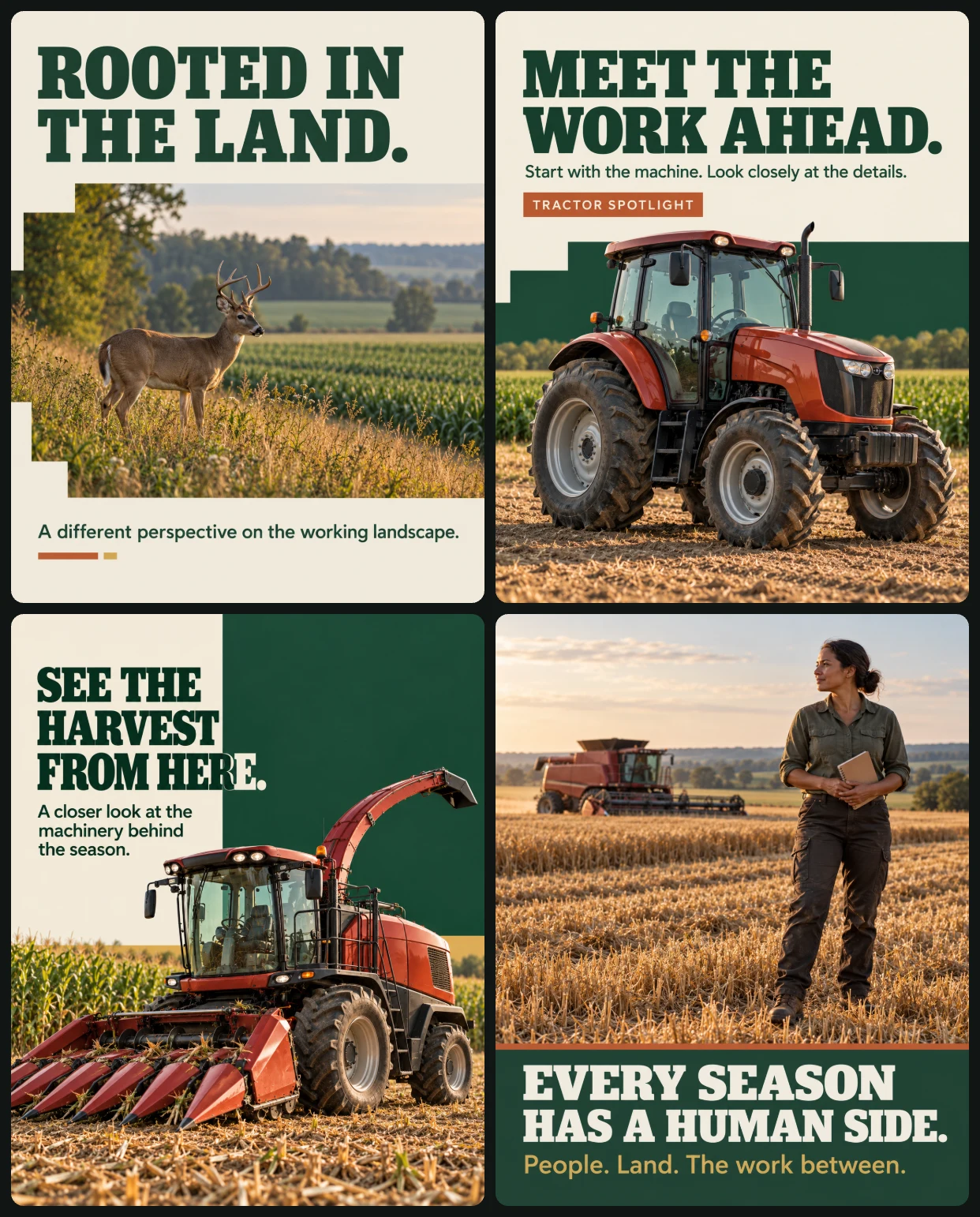
DESIGN 1 — CONNECTION TO THE LAND
Warm limestone canvas.
Place a large landscape photograph across the middle 65%, extending to the right edge, with an asymmetric stepped crop at left.
Show a deer standing naturally at the edge of a cultivated field in early morning. Position it toward the right in three-quarter profile, surrounded by grasses and a distant tree line.
Keep anatomy and antlers plausible. Do not reproduce an isolated frontal deer or brand-like deer emblem.
Forest-green headline above the photograph:
“ROOTED IN
THE LAND.”
Supporting copy below:
“A different perspective on the working landscape.”
Add a short copper rule and a small wheat-gold rectangle.
Camera character: Nikon Z8, 200mm lens, approximately f/5.6, 1/800 second, ISO 400–800 as light requires.
Soft directional morning light. Deer clearly resolved, grasses and distant trees naturally softer. Restrained atmospheric separation only in the distance.
DESIGN 2 — TRACTOR HERO
Limestone background.
Place a tractor in a low three-quarter view across the lower 60%, resting on compacted field soil. Keep complete wheels visible.
Behind it, place a broad forest-green horizontal panel with a stepped upper edge. Let the cab extend above the panel.
Use supplied machinery exactly.
Fictional fallback:
An unbranded utility tractor with a copper-red body, charcoal chassis, enclosed cab, and realistically proportioned agricultural tires.
Headline at upper left:
“MEET THE
WORK AHEAD.”
Supporting copy:
“Start with the machine. Look closely at the details.”
Small copper caption tab:
“TRACTOR SPOTLIGHT”
Camera character: Canon EOS R5, 50mm lens, approximately f/8, 1/250 second, ISO 100–200, daylight white balance near 5500K.
Large soft daylight from camera left, natural ground fill, realistic tire contact, coherent glass reflections, and retained chassis shadow detail.
DESIGN 3 — HARVEST MACHINERY
Forest-green background with a limestone information column occupying the left 35%.
Place the machine in the lower-right area in a slightly elevated three-quarter view on a harvested field. Its header may overlap the lower part of the limestone column without obscuring text.
Use a narrow wheat-gold horizontal band behind the lower machine, suggesting a field horizon.
Preserve supplied machine type and construction exactly.
Fictional fallback:
A plausible unbranded self-propelled forage harvester with a copper-red body, charcoal chassis, and appropriately connected maize header.
Headline in the limestone column:
“SEE THE
HARVEST
FROM HERE.”
Supporting copy:
“A closer look at the machinery behind the season.”
Camera character: full-frame camera, 70mm lens, approximately f/8, 1/500 second, ISO 200–400, neutral daylight white balance.
Soft late-afternoon side light, believable crop residue, subdued reflections, and grounded tire shadows.
No technical callouts, speech bubbles, or unsupported capability icons.
DESIGN 4 — PEOPLE AND THE SEASON
Photographic field scene across the upper 78%.
Place an adult at viewer right in a natural three-quarter pose, looking across the field and holding a plain notebook at waist level.
Preserve a supplied person’s identity.
Otherwise use an original adult woman with medium-brown skin, dark tied-back hair, olive work shirt, dark utility trousers, and practical boots.
Place a combine harvester in the middle distance at viewer left, separated clearly from the person.
Use supplied machinery faithfully.
Fictional fallback:
A plausible unbranded copper-red combine with an appropriate grain header.
Show an earthy late-afternoon field, natural crop variation, and a quiet sky.
Across the lower 22%, place a forest-green rectangular footer with a thin copper rule along its upper edge.
Warm limestone headline:
“EVERY SEASON
HAS A HUMAN SIDE.”
Small wheat-gold supporting line:
“People. Land. The work between.”
Camera character: Sony A7 IV, 50mm lens, approximately f/5.6, 1/320 second, ISO 200–400.
Warm side light, neutral skin tones, gentle shadow detail, and natural depth separation. Person clearly resolved; distant machinery recognizable but slightly softer.
FINAL CHECK
Deliver four separate portrait artworks.
Preserve agricultural character and technical credibility.
Keep machinery mechanically coherent and supplied identities faithful.
Maintain clear typography, consistent colors, distinct compositions, and natural photographic detail.
Render only the specified copy.