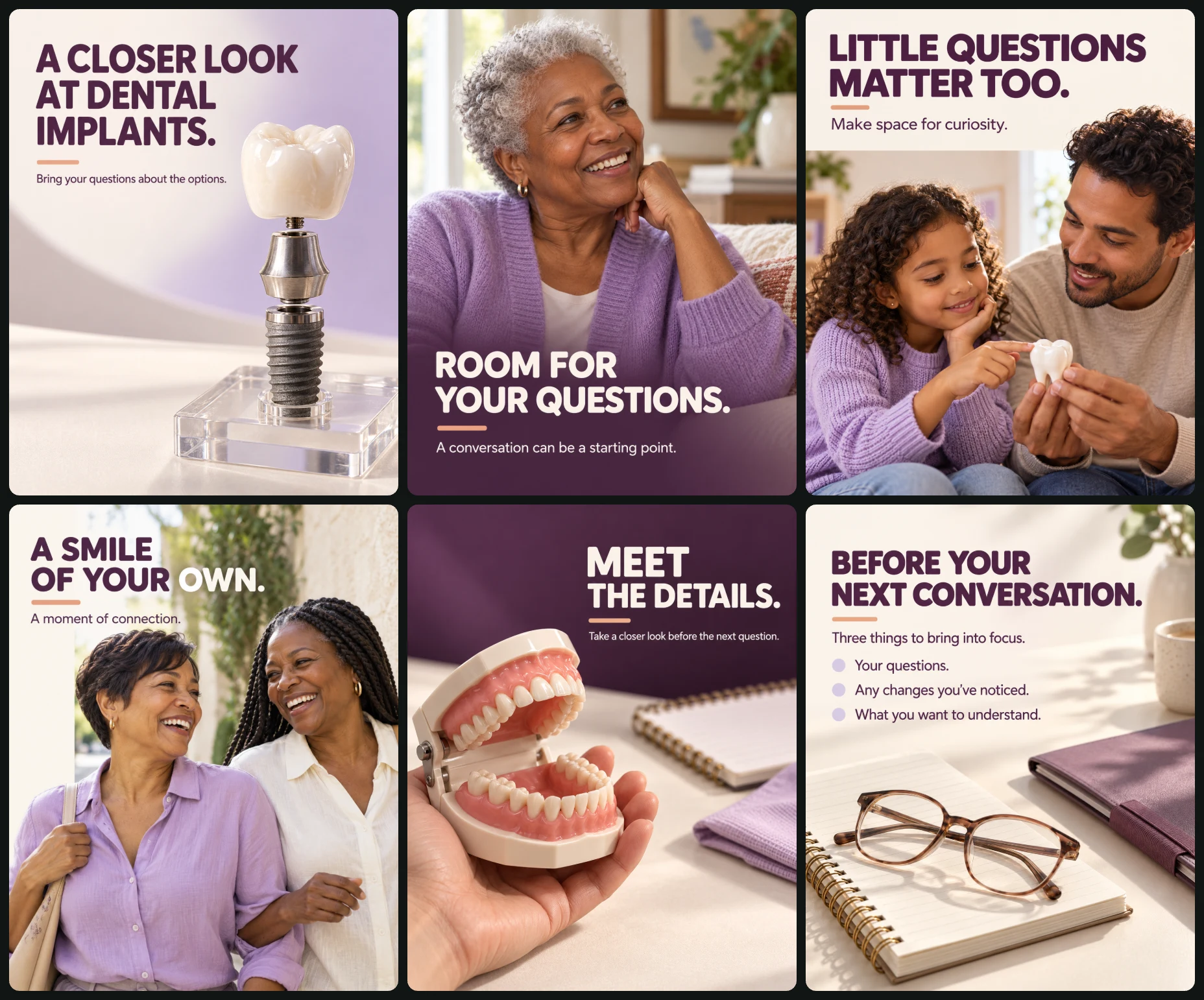
Campaign set · 6 images
Dental Clinic Instagram Post Set
Instagram Post Sets
Way 2 · only some AI modelsThe whole set at onceOne master prompt that makes every design together.
Master prompt
Use this only if your AI model can make many images together in one go (multi-image generation). If it makes one image at a time, the result will not match. Use the separate prompts below instead.
Create a coordinated six-image dental social media campaign.
CREATIVE OBJECTIVE
Preserve the reference’s welcoming smiles, clear dental subjects, bright clinical atmosphere, and bold readable typography.
Develop original layouts, photographic compositions, copy, colors, and visual structures.
VISUAL RICHNESS
The campaign must have photographic depth and material character.
Mix:
• Dimensional dental-model photography.
• Intimate environmental portraits.
• Natural lifestyle movement.
• Foreground and background layering.
• Tactile tabletop still lifes.
Do not turn every design into a flat vector layout, repeated rounded card, or basic text-and-photo split.
Use shadows, perspective, selective focus, and controlled overlaps where appropriate.
Keep graphic elements restrained so the imagery remains the main source of depth.
OUTPUT
Generate 6 separate finished images, one per numbered brief.
Each image must have its own complete 4:5 portrait canvas.
Do not combine them into a collage, grid, contact sheet, or multi-panel image.
If necessary, generate the images sequentially.
Deliver flat finished artwork without presentation gutters, screens, software interfaces, or surrounding rooms.
OPTIONAL INPUTS
• Approved dental-model or device photographs
• Approved staff photographs and verified roles
• Personal photographs
• Clinic photographs
• Clinically reviewed educational copy
• Approved replacement copy
• Approved brand assets
Treat blank fields as absent. Never print placeholders.
INPUT HANDLING
Use supplied photographs and confirmed information first.
Preserve personal identities, ages, skin tones, facial features, hairstyles, body proportions, and natural teeth.
Do not whiten, reconstruct, or perfect smiles to imply treatment results.
Preserve supplied dental-model anatomy, device construction, facility layout, and actual materials.
Without approved staff imagery, do not invent identifiable clinic employees or clinician credentials.
Illustrative people must not be presented as patient testimonials.
Do not imply a treatment outcome from a smiling portrait.
MEDICAL ACCURACY
Use approved supplied anatomical and device references first.
Maintain plausible tooth arrangement, jaw structure, implant components, and model connections.
Do not invent diagnostic findings, procedure details, suitability, success rates, recovery times, treatment availability, prices, or guarantees.
Any additional clinical advice must come from supplied clinically reviewed copy.
CAMPAIGN IDENTITY
Deep plum: #51364F
Soft lilac: #DED5EA
Warm ivory: #F7F3EB
Muted apricot: #E7B89B
Keep the campaign warm, clear, and reassuring.
Preserve natural skin, teeth, materials, and photographic colors.
Do not tint all images purple.
TYPOGRAPHY
Confident rounded humanist sans serif.
Bold headlines, restrained regular supporting text.
Comfortable line spacing and approximately 7% safe margins.
No squeezed lettering, excessive condensation, crowded paragraphs, or tiny filler text.
If replacement copy is too long, simplify it while retaining its approved meaning rather than compressing the typography.
GRAPHIC LANGUAGE
Asymmetric photographic crops, occasional narrow columns, restrained tonal washes, small rules, and minimal circular markers.
Avoid copying the reference’s blue-white palette, exact panel shapes, giant cross, floating brand tags, translucent rounded frame, and headline arrangements.
PHOTOGRAPHIC DIRECTION
Full-frame commercial editorial photography.
People:
50–85mm lens, f/4, 1/200–1/500 second, ISO 200–400.
Dental models and still lifes:
70–100mm macro lens, f/8, ISO 100–200, 1/160 second.
Neutral white balance around 5200K, adjusted to actual light.
Use large soft directional keys, gentle bounce, controlled reflections, and coherent contact shadows.
Keep principal details clear with gradual softness through depth.
Retain natural skin variation, modest age-related detail, real fabric folds, and subtle paper texture.
Avoid hard sharpening, HDR halos, exaggerated pores, beauty-filter skin, fake teeth, excessive gloss, artificial glow, theatrical haze, blanket grain, and global blur.
COPY
Render only the exact English copy below.
No logos, invented clinic names, contact information, websites, QR codes, credentials, prices, signatures, or watermarks.
DESIGN 1 — DENTAL IMPLANT DETAIL
Ivory studio surface curving into lilac background.
Approved implant demonstration model in lower-right half:
crown, abutment, and fixture aligned in a plausible exploded educational arrangement.
Plum headline at upper left:
“A CLOSER LOOK
AT DENTAL
IMPLANTS.”
Supporting copy:
“Bring your questions about the options.”
100mm macro, f/8.
Broad side-back diffusion, realistic material separation, subtle grounded shadow.
No suitability or outcome claims.
DESIGN 2 — ROOM FOR YOUR QUESTIONS
Full-bleed environmental portrait.
Original older adult woman with dark skin, short silver curls, and lilac cardigan, unless a personal photograph is supplied.
Seated comfortably, smiling naturally toward someone outside frame.
No invented clinician behind her.
Restrained plum tonal wash across lower text area.
Ivory headline:
“ROOM FOR
YOUR QUESTIONS.”
Supporting copy:
“A conversation can be a starting point.”
Short apricot rule.
85mm, f/4, soft window light.
Natural teeth and age-related skin detail.
DESIGN 3 — LITTLE QUESTIONS MATTER TOO
Warm-ivory upper text area.
Photo across lower 75%.
Original school-age child with medium-brown skin and dark curly hair seated beside an adult caregiver, unless identities are supplied.
They look at a small plain tooth-shaped teaching model held by the caregiver.
Child-eye-level viewpoint and natural curiosity.
Plum headline:
“LITTLE QUESTIONS
MATTER TOO.”
Supporting copy:
“Make space for curiosity.”
Small apricot accent.
50mm, f/4, soft lateral light.
No invented examination or instruments inside the mouth.
DESIGN 4 — A SMILE OF YOUR OWN
Candid outdoor photograph beside a pale textured wall.
Two distinct original adults:
Woman with light-brown skin and short dark hair.
Woman with dark skin and long natural braids.
Waist-up framing, one slightly nearer camera, laughing naturally together.
Preserve supplied identities when available.
Photograph fills most of canvas, narrow ivory column at left.
Headline integrates column and quiet image area without obscuring faces.
Headline:
“A SMILE
OF YOUR OWN.”
Supporting copy:
“A moment of connection.”
Plum text on ivory, ivory text over photograph.
50mm, f/4, 1/500 second, soft open shade.
No cosmetic-result implication.
DESIGN 5 — MEET THE DETAILS
Close photographic scene from slightly above a tabletop.
Approved real staff imagery if supplied.
Otherwise only an adult hand securely holding a plain dental teaching model.
Model lower-left foreground.
Notebook and folded lilac cloth farther back.
Plum background softly meets ivory tabletop.
Ivory headline upper right:
“MEET
THE DETAILS.”
Supporting copy:
“Take a closer look before the next question.”
Apricot underline.
100mm macro, f/8.
Natural hand, plausible model hinge and tooth arrangement.
DESIGN 6 — BEFORE YOUR NEXT CONVERSATION
Tactile still life on ivory tabletop:
plain notebook, reading glasses, closed folder.
Gentle overhead angle, no personal medical information.
Plum headline:
“BEFORE YOUR
NEXT CONVERSATION.”
Supporting copy:
“Three things to bring into focus.”
Three generously spaced lines:
“Your questions.”
“Any changes you’ve noticed.”
“What you want to understand.”
Small lilac markers and restrained apricot rule.
No button-style checklist.
70mm, f/8, soft side light.
Conversation prompts only, not a treatment plan.
FINAL CHECK
Deliver six separate portrait artworks.
Maintain warm dental character, photographic richness, varied compositions, and comfortable typography.
Preserve supplied people, natural teeth, and accurate models.
Check anatomy, device structure, reflections, contact shadows, text spacing, and exact spelling.
All 6 images in this set
Each image has its own prompt. Tap an image to see it bigger.
Create one finished 4:5 portrait dental educational advertisement.
VISUAL DIRECTION
Dimensional medical-product photography combined with elegant editorial typography. Deep plum #51364F, soft lilac #DED5EA, warm ivory #F7F3EB, muted apricot #E7B89B.
COMPOSITION
Use an ivory studio surface curving gently into a lilac background.
Place one anatomically plausible dental implant demonstration model in the lower-right half: crown, abutment, and implant fixture aligned vertically in a clearly intentional exploded educational arrangement. Maintain consistent scale and explainable component connections.
Use an approved supplied implant model or reference first. Do not invent a commercial device or imply universal compatibility.
Plum headline at upper left:
“A CLOSER LOOK
AT DENTAL
IMPLANTS.”
Supporting copy:
“Bring your questions about the options.”
TYPOGRAPHY
Confident rounded humanist sans serif, bold headline, restrained regular supporting text. Keep comfortable line spacing and 7% margins. Do not squeeze text around the model.
LIGHTING AND FINISH
Full-frame studio character, 100mm macro lens, f/8, ISO 100, 1/160 second, 5200K. Broad side-back diffusion, white reflection cards, subtle shadow beneath the demonstration model.
Differentiate ceramic-like crown, matte demonstration material, and metal fixture. Restrained reflections, natural edge softness, no jewel-like shine or harsh sharpening.
No treatment recommendation, suitability claim, success rate, price, logo, contact details, QR code, or watermark. Flat finished artwork.
Room for your questions
Create one finished 4:5 portrait dental-care campaign advertisement.
PEOPLE INPUT
Use approved supplied photographs faithfully, preserving identities, ages, skin tones, and actual setting.
Without input, show an original older adult woman with dark skin, short silver curls, and a lilac cardigan, seated comfortably in a bright neutral consultation room. Do not imply a verified patient testimonial or treatment result.
COMPOSITION
Full-bleed waist-up portrait, subject slightly left of center, smiling naturally toward someone outside the frame. Keep the smile individual and believable, without whitening or reconstructing teeth.
Let soft architectural depth and a gently blurred chair establish the room. Avoid an invented clinician in the background.
Place a restrained plum #51364F tonal wash only across the lower text area, allowing the photograph to remain visible.
Ivory #F7F3EB headline:
“ROOM FOR
YOUR QUESTIONS.”
Supporting copy:
“A conversation can be a starting point.”
Use rounded humanist sans serif, broad readable lines, and one short apricot #E7B89B rule. No floating label beside the headline.
PHOTOGRAPHY
Canon EOS R6 Mark II character, 85mm lens, f/4, 1/200 second, ISO 400, neutral white balance around 5200K. Soft window key, gentle bounce, natural age-related skin detail, gradual background softness.
No plastic skin, excessive pores, fake teeth, hard sharpening, clinical promises, logos, contact information, or watermark.
Little questions, big curiosity
Create one finished 4:5 portrait child-focused dental conversation advertisement.
IDENTITY
Preserve supplied identities and relationships.
Without input, show an original school-age child with medium-brown skin and dark curly hair seated beside an adult caregiver in a bright, neutral waiting area. Both look at a small plain tooth-shaped teaching model held by the caregiver.
Do not imply that the illustrative subjects are actual patients.
COMPOSITION
Photographic scene across the lower 75%, framed at the child’s eye level. Child at viewer right, caregiver partly visible at left. Natural curiosity and relaxed posture rather than an exaggerated examination pose.
Warm-ivory #F7F3EB upper area with a soft lilac #DED5EA photographic transition.
Plum #51364F headline:
“LITTLE QUESTIONS
MATTER TOO.”
Supporting copy:
“Make space for curiosity.”
Rounded humanist sans serif, bold headline, small apricot #E7B89B accent. Keep faces and hands clear.
PHOTOGRAPHY
Full-frame camera, 50mm lens, f/4, 1/250 second, ISO 400, neutral daylight white balance. Soft lateral light, realistic skin, modest room depth.
No instruments inside the mouth, fabricated procedure, cartoon-perfect teeth, hard sharpening, pediatric-service claim, treatment promise, logos, contacts, QR codes, or watermark.
Natural smiles, shared connection
Create one finished 4:5 portrait dental lifestyle campaign poster.
STYLE
Expressive photographic editorial composition with depth and natural movement. Plum #51364F, lilac #DED5EA, ivory #F7F3EB, restrained apricot #E7B89B.
PEOPLE
Preserve supplied personal identities.
Otherwise create two distinct original adults: a woman with light-brown skin and short dark hair, and a woman with dark skin and long natural braids.
COMPOSITION
Candid photograph of the pair laughing together outdoors beside a pale textured wall. Frame from the waist upward, with one person slightly nearer the camera to create depth.
Keep teeth and facial features natural. Do not alter their smiles to imply cosmetic results.
Use an asymmetric crop: photograph fills most of the canvas, with a narrow ivory column at viewer left. Place the headline partly within the column and partly over a quiet darker area of the image.
Headline:
“A SMILE
OF YOUR OWN.”
Supporting copy:
“A moment of connection.”
Use plum lettering on ivory and ivory lettering over the image. Rounded humanist sans serif with comfortable spacing. No translucent rounded card or full-image color filter.
PHOTOGRAPHY
Full-frame camera, 50mm lens, f/4, 1/500 second, ISO 200–400. Soft open shade, natural skin and movement, subtle depth falloff.
No testimonial implication, guaranteed happiness, fake teeth, beauty-filter skin, heavy sharpening, logos, contacts, or watermark.
Dental details, up close
Create one finished 4:5 portrait dental educational advertisement.
INPUT
Use approved staff imagery and verified roles if supplied. Preserve the actual person, model, instruments, and setting.
Without input, show only a natural adult hand holding a plain dental teaching model above a tabletop. Do not invent a clinician identity.
COMPOSITION
Close photographic view from slightly above the table.
Place the teaching model in the lower-left foreground, with a softly resolved notebook and a folded lilac cloth farther back. The hand supports the model securely; its jaw hinge and tooth arrangement are plausible.
Plum #51364F background transitions softly into an ivory #F7F3EB tabletop.
Ivory headline in the open upper-right area:
“MEET
THE DETAILS.”
Supporting copy:
“Take a closer look before the next question.”
Rounded humanist sans serif with bold headline and small regular supporting copy. Add one apricot #E7B89B underline.
PHOTOGRAPHY
Full-frame camera, 100mm macro lens, f/8, ISO 100–200, 1/160 second, 5200K. Large soft key, controlled model highlights, natural hand texture, coherent shadows, gradual depth separation.
No giant medical cross, unrealistic teeth, unsupported procedure, invented credentials, health-outcome promise, branding, contacts, or watermark.
Before your next dental conversation
Create one finished 4:5 portrait dental information poster.
VISUAL DIRECTION
Editorial still life with tactile depth, rather than a flat checklist.
Warm-ivory #F7F3EB background and tabletop. Place a plain notebook, reading glasses, and a closed document folder across the lower half, photographed from a gentle overhead angle.
The notebook is open but contains no personal or invented medical information.
Plum #51364F headline at upper left:
“BEFORE YOUR
NEXT CONVERSATION.”
Supporting copy:
“Three things to bring into focus.”
Arrange three short text lines in generous open space above the still life:
“Your questions.”
“Any changes you’ve noticed.”
“What you want to understand.”
Use small lilac #DED5EA circular markers and one restrained apricot #E7B89B rule. Do not place every line inside a button or card.
TYPOGRAPHY
Rounded humanist sans serif, bold headline, readable regular supporting text. Shorten approved replacement copy rather than squeezing it.
PHOTOGRAPHY
Full-frame camera, 70mm lens, f/8, ISO 100, 1/160 second, neutral 5200K. Soft side light, subtle paper fibers, natural shadows, restrained reflections.
These are conversation prompts, not a dental treatment plan. No invented brushing instructions, appointment schedule, clinician, service guarantee, logos, contacts, QR codes, or watermark.